

The Wisconsin Triennial recently opened at the Madison Museum of Contemporary Art (MMoCA) in Madison, Wisconsin. The artists were selected through a rigorous jury process undertaken by MMoCA's curatorial team. The final roster of artists represents a range of individuals at all points in their careers and highlights what is current in the Wisconsin art scene. This year the paintings of Tory Folliard Gallery artists, Ben Grant and TD Brenner were selected for this exhibition. The Triennial continues through February 16. 2020.
A World of Crazy Colors
* To read this article on the Urban Milwaukee website, please click HERE
A World of Crazy Colors
Artist’s TL Solien’s odd, uneasy narratives featured at Tory Folliard Gallery.
By Catherine Jozwik - Sep 26th, 2019

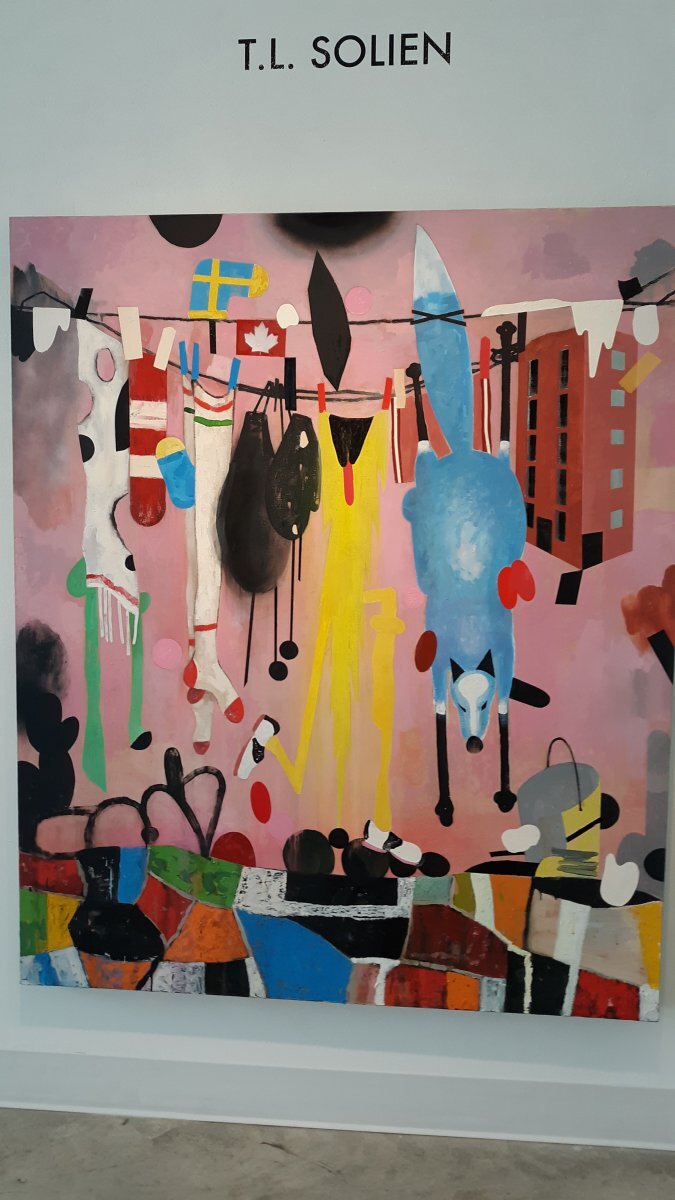
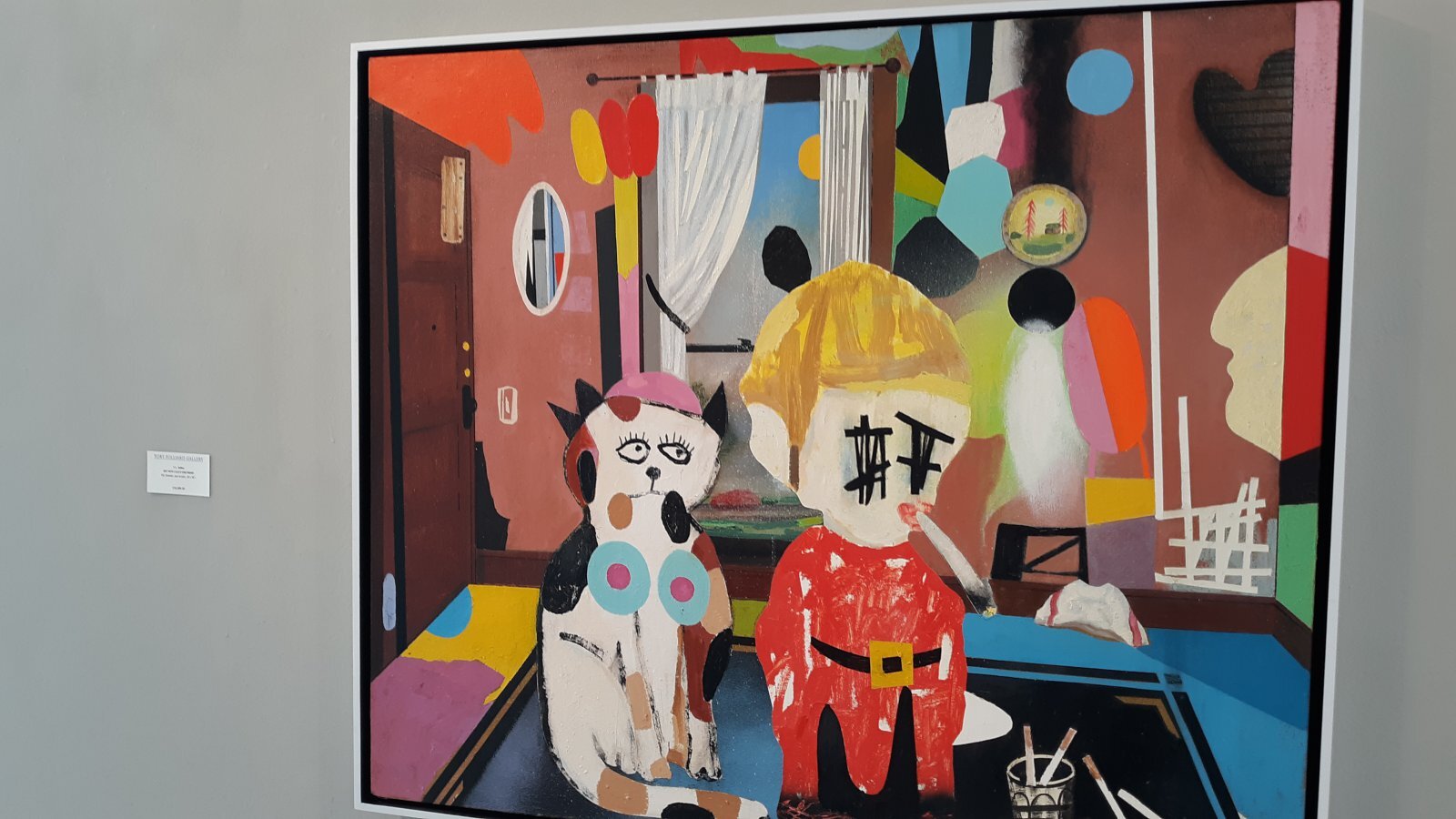
A work from TL Solien’s Forest Fighter/Black Eye Joke. Photo by Catherine Jozwik.
The Tory Folliard Gallery’s current exhibition, of Madison-based artist’s TL Solien’s Forest Fighter/Black Eye Joke, showcases 11 of the longtime artist’s innovative still life and portraiture paintings. It is on display through October 12.
Solien’s work was also displayed in the gallery’s recent exhibition, Nature Morte, named after one of his still life paintings.
For more than 40 years, Solien, also a professor of painting and drawing at UW-Madison, has incorporated touches of Americana (of which the artist is a collector) and sociopolitical symbols into his figure paintings, which feature uneasy subjects often struggling with emotional dilemmas.
Solien’s latest exhibition “continues this tradition by pulling viewers into his disquieting orbit of sardonic still lifes, landscapes, and portraiture,” the gallery’s description suggests. Solien favors bold colors, with many of his paintings set against bright blue backgrounds. His paintings, created with oil, acrylic and enamel paints, are absorbing and arresting. According to Becca Sidman, assistant director of the Tory Folliard Gallery, Solien personally hung the paintings lower than normal so the viewer gets the sense of being able to “walk into” them.
The artist pays tribute to cultural movements and fads, such as the fascination with all things Western that gripped America (especially younger people) in the 1950s. Solien also likes to paint contradicting landscapes. “Boy with Paint,” for example, depicts a horse-riding figure dressed in pirate garb, wearing a sailor’s cap, against a backdrop that’s one-part desert, one part urban.
“Not Fade Away” could be a nod to flower power and the hippie moment; a tribute to rock stars like Janis Joplin, Jim Morrison and Jimi Hendrix, who all died prematurely at the age of 27 in the early 1970s.
Solien often paints lone figures, but works like “Boy With Calico Girlfriend,” featuring a figure in a red robe with x’s for eyes, standing next to a dour-looking calico cat wearing a beret, hint at unsatisfying, troublesome interpersonal relationships. Does the cat take the place of a human love interest, or could the cat suggest human qualities, such as fickleness, pride and independence? “Greensleeves” portrays a clothesline with clothes, as well as a fox, hung upside down in the forefront of a tall apartment complex.
“Forest Fighters/Black Eye Joke presents a broadly contextualized culture of interactive characters, engaged “in the ‘intimacies’ of interpersonal relationships, or the absence thereof,” writes Solien.
Sports and competition are recurring motifs in Solien’s works. Works such as “Hail Mary” and “Forest Fighter” depict athletes. Boxing gloves, which could represent external or internal conflict, appear in several of Solien’s paintings, including “Greensleeves” “Le Souris Morte,” and “Boy On Paint.”
The artist’s still lives — “Nature Morte,” “Theorem,” and “Le Souris Morte,” for examples—depict half-eaten fruits, a handbag bursting with forgotten household items, and geometric shapes, such as crisp black circles, reminiscent of graphic arts. In “Nature Morte,” Solien perhaps comments on American holidays and how they are faithfully observed. The painting portrays a Thanksgiving turkey with what appears to be white-gloved hands. The “gloves” could also represent the perceived formality of the holiday, or at least how it was observed years ago.
“Collectively, the paintings, works on paper and objects, will exist as ‘episodes,’ or ‘vignettes’ illuminating an ‘allegorically’ expansive narrative, in which the subjective concerns within the depicted culture weave through interpersonal moments of intellectual and emotional crisis,” concludes Solien in his artist statement.
Tom Uttech: Into the Woods
* To read this article on the MoWA website, please click HERE
On View: October 12, 2019–January 12, 2020
Note new date! Opening Party: Saturday, October 12 | 2:00–5:00
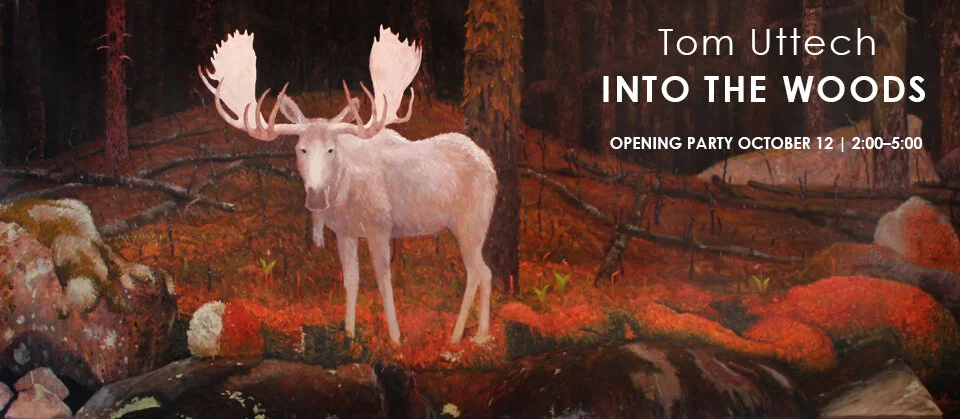
Wisconsin native Tom Uttech is recognized as one of the leading landscape painters working today in the United States. Often categorized as a Magic Realist, his paintings weave together a mystical world of both imagined and real elements. Uttech’s paintings are easily identifiable by their complex devotion to nature, one that is equally raw and wild and familiar and inviting. His inspiration derives from decades of travel to Northern Minnesota and the Quetico Provincial Park in Ontario, Canada. Uttech’s world is one of waterways, shorelines, and tumbling rocks precariously perched within thickets of growth.
Over the last decade, Uttech’s enchanted forests have become home and stage to animal migration, a natural phenomenon rooted in eons of animal behavior and evolution. Part fantasy, part natural science, these migration paintings are compelling not only for their settings but for the hundreds of species of animals flying, swarming, and bolting across his paintings on a timeless mission and in a perpetual state of reenactment. Uttech does not identify as an environmental artist, but his treatment of the migration subject has become synonymous with encroaching dangers that finds resonance in contemporary issues of wildlife preservation. Uttech is in many ways most comfortable in the north woods or the forests that surround his forty-acre farm in Saukville, Wisconsin, which is also home to his converted barn-studio.
Into the Woods is the artist’s first full-career retrospective that will include never before seen early paintings and drawings as well as a number of his large-scale migration series paintings from the last decade. In anticipation of the exhibition, MOWA commissioned Nin Gassinsibingwe, the most recent and in many ways most spectacular painting in his ongoing migration series. The Ojibwe title translates as: “I Wipe My Tears.” The exhibition is accompanied by a major gift of almost two hundred photographs that was made possible by the artist and the Kohler Foundation, Inc. The exhibition is curated by Executive Director Laurie Winters.
Richard Taylor featured on WUWM's All Things Considered
* To read this article on the WUWM NPR website, please click HERE
New Sculptures Honor Milwaukee Road Railway Workers
By CHUCK QUIRMBACH • MAY 16, 2019

The first two "People of the Road" sculptures in the Menomonee Valley.
CHUCK QUIRMBACH
A series of metal sculptures taking shape in Milwaukee's Menomonee Valley honors the men and women who worked at a now-lost transportation giant. The "People of the Road” monument is a tribute to the thousands who labored for a passenger and freight-rail service best known as the Milwaukee Road.
The railroad was officially known in its later years as the Chicago, Milwaukee, Saint Paul and Pacific. That's because in its heyday it operated on 10,000 miles of track in the Midwest and Pacific Northwest. But for much of the carrier’s nearly 140 years, Milwaukee was a key part of the company's success. A huge railcar and locomotive shop at the southwest corner of the Menomonee Valley employed more than 5,000 people.
When that building closed, and the financially troubled railroad dissolved in the 1980s, it was a mournful time in the city, as captured in the 1987 song Come Bugle Blow by Milwaukee folksinger Larry Penn.
Penn sang, "And what can you play, for a ragged old soul, but taps for the Milwaukee Road? Come bugle blow, for the Milwaukee Road, a rusty old road, a crusty old road. Come bugle blow, for a busted old road, for the Milwaukee Road, bugle blow.”
Forty-two years later, the passing of the Milwaukee Road no doubt remains painful to many. But others are hoping time has healed some of the wounds. Former Milwaukee Mayor John Norquist recently tried to offer a humorous remembrance.
"I remember the workers coming out of here, going through the tunnel across the river, and then going to the National Liquor Bar to cash their checks," he says.
Norquist spoke this month at an unveiling of two of the five sculptures that are planned for the “People of the Road” monument. The monument is going up along the Hank Aaron State Trail, just west of the 35th Street viaduct. It's in Menomonee Valley Community Park, which is where the railcar shop was.
In attendance of the unveiling was David Pierce, who briefly worked for the Milwaukee Road.
"I was what you call a gandy-dancer. So, I used an 8-pound maul hammer, and I would pound spikes into the rail and we repaired the track. It was a federal project to repair them from Wauwatosa to Watertown. That was my three-month career with the Milwaukee Road. I was glad to move on," Pierce recalls to WUWM.
Other members of the Pierce family stayed longer. A brother worked for the Road as an electrician, while their father and grandfather were locomotive engineers. David Pierce says he's glad to see the sculptures.
"I think it's important that organized labor is recognized. We were in a union there, and that was a way for the workers to be treated fairly, in safe working conditions. There was always someone to look out for you." Pierce remembered.
The person looking out now for the story of the workers is the creator of the sculptures, Milwaukee artist Richard Taylor.
Taylor says his father worked briefly for the Milwaukee Road. But the artist hopes the monument honors all the workers.

Milwaukee sculptor Richard Taylor stands in his Riverwest studio. Before him is a maquette, or scale model, of the "People of the Road" monument.
CREDIT CHUCK QUIRMBACH
"I know I could have gone in other directions, with the iconography of the locomotives and the railcars, the tracks, and that sort of thing. But I thought the people should really be honored because it was such a rich history. It supported so many workers and families for decades and decades," he says.
Taylor says old photographs of the Milwaukee Road facility inspired the sculptures. One of the artworks features a male worker standing on a small trackside water tower while positioning a part to a rail vehicle. The other sculpture features a c-shaped railroad roundhouse standing on edge. A male worker swinging a sledgehammer stands next to the roundhouse, while a female worker stands on top holding a large monkey wrench.

Richard Taylor operates a metal grinder in his studio.
CREDIT CHUCK QUIRMBACH
"We wanted to emphasize that there were women who did heavy work, did mechanical work, were employed by the Milwaukee Road in doing assembly and hard work," Taylor said.
The sculptures are in silhouette, meaning they look 2D and you can't make out the workers faces. Deliberate choices, says Taylor.
"The silhouettes let each one of us fill in these figures with, who knows? Maybe someone we know who resembles the physiognomy of that person. Maybe a relative. Maybe someone we know who worked on the railroad becomes one of these figures." He continued, "It also let me overlay the figures with a little bit of railroad track, sort of imprint them with the railroad, or second the notion that yes, these are people of the Road."Taylor was recently given the go-ahead to work on the third sculpture. He hopes to have it up by August. The Friends of the Hank Aaron State Trail is still trying to raise money for the other two figures.
Taylor says he understands that the layoffs of thousands of people more than four decades ago still doesn’t sit well with some.
"It is a rather bittersweet topic. But there are wonderful memories. There are people like my father who have great memories and great pride in the time he spent working on the railroad," Taylor concluded.
So, maybe, in a city that likes to offer toasts, that's another way to look at the new sculptures: as a celebration of a vibrant time in Milwaukee. Larry Penn said much the same in another verse of his song.
"So, drink if you like to the railroad men, lusty old men, Milwaukee Road men. And drink if you can in the taverns they been, to the days on the old Milwaukee Road," Penn sang.
Nature Morte Exhibition Reviewed In Urban Milwaukee
*to read this article on the Urban Milwaukee website please click HERE
Let Us Now Praise The Still Life
Tory Folliard’s “Nature Morte” show is a rich roundup of still life works by more than 30 artists.
By Catherine Jozwik - Aug 15th, 2019 05:28 pm
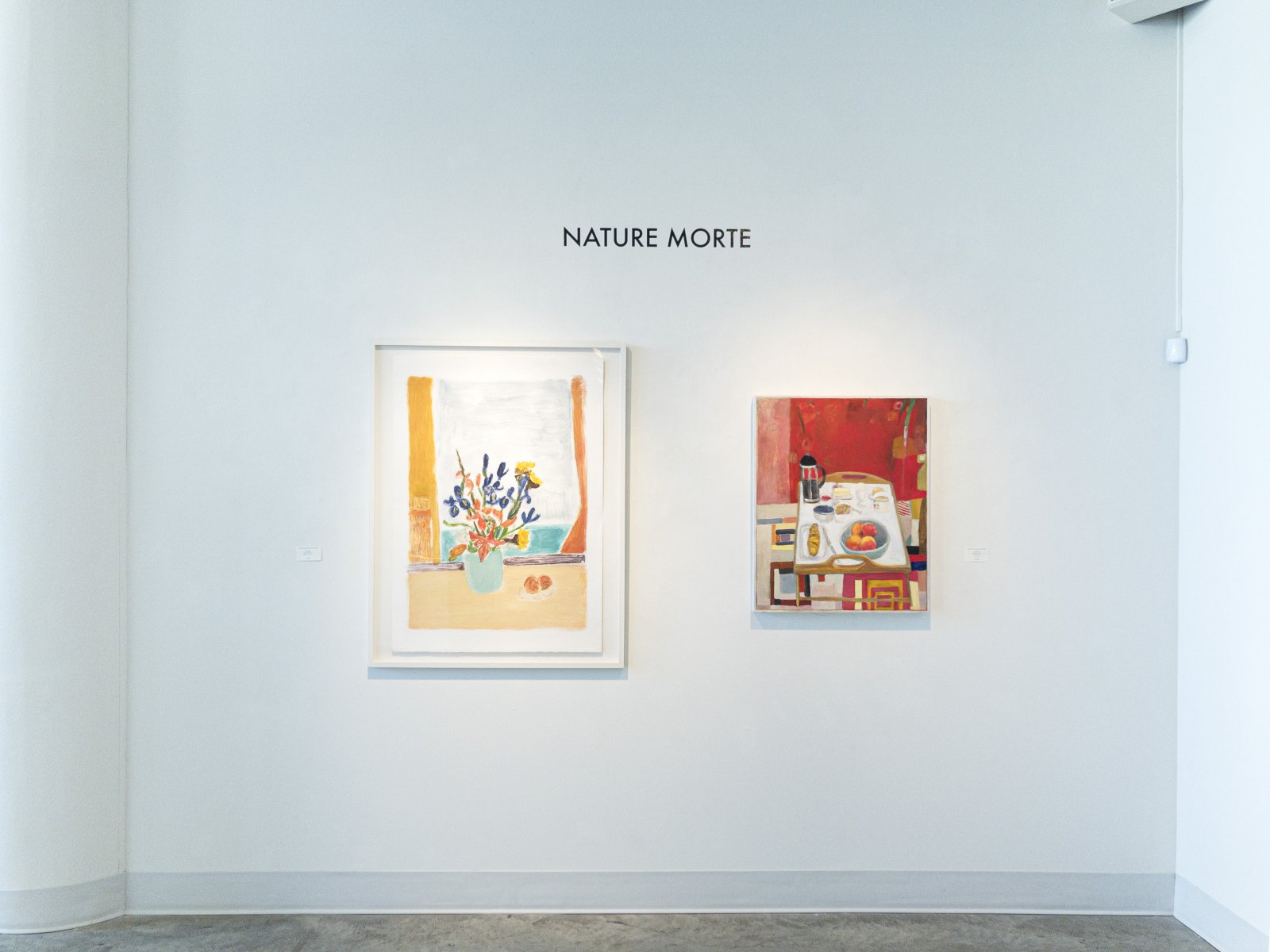
Nature Morte: An Exhibition of Contemporary Still Life Gallery. Photo courtesy of the Tory Folliard Gallery.
The Tory Folliard Gallery’s current exhibit, Nature Morte: An Exhibition of Contemporary Still Life, is a modern look at the genre of still life, from glass sculptures and stoneware carvings to surrealistic oil and vividly-colored, Impressionistic acrylic paintings.
On display through September 7, the exhibit showcases works in different media by more than 30 artists, many of them Wisconsin-based: Mary Bero, Chris Berti, Craig Blietz, TD Brenner, Derrick Buisch, Robert Cocke, Marion Coffey, Laura Dronzek, Beth Edwards, Andy Fletcher, Ron Isaacs, Beth Lipman, Dylan Martinez, Lon Michels, Mark Mulhern, Katie Musolff, Dennis Nechvatal, Michael Noland, Todd Olson, Melanie Parke, Guzzo Pinc, Jeremy Popelka, Bill Reid, Jeffrey Ripple, Jim Rose, Jan Serr, George Shipperley, T.L. Solien, Fred Stonehouse, Paula Swaydan Grebel, Stephanie Trenchard, Mary Alice Wimmer, John Wilde, and Janica Yoder.
Still life is one of the oldest art forms, dating to Greek and Roman times. Western Renaissance artists, among them Netherlandish painter Bruegel the Elder and Italian painter Caravaggio, helped popularize the genre, which became extremely popular, especially among art collectors.
“Still life painting has incredible staying power as a genre in art. The idea that we should reflect on the transience and ultimate vanity of existence has a particularly modern, even existential appeal,” Stonehouse is quoted as saying.
Many may consider still life to be paintings of fruit bowls and flower vases. But while some contemporary artists employ traditional themes and styles in their works, still life as a genre goes far beyond that. Nature Morte features works in diverse media, such as oil and acrylic, blown glass, repurposed steel, birch plywood, silverpoint drawings, carved limestone and sand castings.
Although many Nature Morte subjects portrayed are inanimate objects—Wimmer’s “Remains III (Skull), a silverpoint drawing of an animal skull, Andy Fletcher’s “Beers of My Fathers,” (an oil-on canvas painting of vintage beer cans) and Jim Rose’s patchwork-like steel cabinet, for examples–the exhibit bursts with life, evidencing that still life as a genre is anything but static and boring.
Artists such as Melanie Parke, Mark Mulhern and T.L. Solien incorporate breathtaking colors in their paintings of flower vases, household items and geometric objects. Solien’s eye-catching “Theorem: Liar’s Paradox,” a vibrant medley of fruits, household objects, and shadows in a style reminiscent of graphic arts, hangs on the wall behind the gallery’s reception desk.
Fred Stonehouse and Robert Cocke’s surrealistic paintings (especially Stonehouse’s crying vegetables) add a dreamlike fantasy element to the exhibit. Jeremy Popelka and Dylan Martinez’s exquisite glass pieces highlight the artists’ incredible skill and patience with such a volatile medium. Popelka’s purple floral piece is lovely, and Martinez’s works depicting plastic bags filled with water are amazingly realistic. Stephanie Trenchard’s “Nature Morte Sur Les Tetes,” which appears to be paper cutouts of upper torsos of 1920s figures encased in sand-cast glass, and Chris Berti’s stone-carved vegetables are exciting departures from the traditional portraiture genre. Rose’s steel cabinets demonstrate the artist’s resourcefulness and ingenuity in creating objects out of discarded items.
Still life was once unfairly regarded as a “lower” art form among critics. Tory Folliard’s delightful, richly complex exhibit proves that this is certainly no longer the case.


Mary Alice Wimmer And Jessica Calderwood Receive Write-Up For Recent Exhibition
The Tory Folliard Gallery is ushering in summer with two new exhibitions by painter Mary Alice Wimmer and metalworker and sculptor Jessica Calderwood.
Read MoreLaurie Hogin Interview From UK Publication Bizarre
Many times in the artistic world we come across extraordinary things, strange things, shocking or simply that they leave you to the void without knowing what emotional path to choose. The first time we saw the works of Laurie Hogin we definitely felt trapped by a mixture of adoration and many questions. A world so colorful and so full of life, but we do not talk about life in its perfectionist image, we talk about real life, the one that catches you, the one that has its good and evil and the one that grabs you, squeezes, the one that you love and hate at the same time and most importantly ... you can not stop living it, because the connection you have is so strong that what happens happens, you keep holding her hand. And if we have to describe what we feel at the moment of seeing the works of Laurie Hogin, perhaps it would be just the moment to squeeze this hand and realize that it is not something else, but life itself.
Read MoreUrban Milwaukee Spotlights Tom Uttech Painting Acquired By MOWA
The Museum of Wisconsin Art recently acquired a large-scale painting by influential Wisconsin landscape artist Tom Uttech, purchased with funds raised from the museum’s 2019 Art Ball.
Held June 15, the Art Ball honored Uttech, presenting him with the Hyde Award, an award which “recognizes individuals and organizations for their significant influence on the Museum of Wisconsin Art and the future of Wisconsin Art. Tom Uttech is the first artist to receive the award,” according to the Tory Folliard Gallery, which has represented Uttech for 27 years.
Read MoreLon Michels' Room At Saint Kate Featured In Chicago Tribune Article
Leopard spots — thousands of them, in a multitude of colors and sizes — cover just about every nook and cranny of one of the 219 guest rooms in Milwaukee’s new Saint Kate hotel, opening Tuesday.
“You have to sign a waiver that if you stay in this room and nine months later you have a child covered in leopard spots, we’re not responsible,” joked Lon Michels, the Wisconsin artist behind the room’s unorthodox, Instagram-darling design.
Read MoreJessica Calderwood Featured In American Craft Magazine
How much of our true selves do we show to the world? When we look at others, do we see who they really are? Can we ever know what lies beneath the surface?
In her enameled paintings and jewelry, Jessica Calderwood captures imaginary characters in private moments and intimate places, with unguarded gestures: face in hands, fingers in mouth, belly button in extreme close-up. Surreal and enigmatic, her portraits have humor, attitude, and charm, but they’re also unsettling, for what they reveal and what they don’t.
Read More
Quisque iaculis facilisis lacinia. Mauris euismod pellentesque tellus sit amet mollis.